
Breastfeeding and Weight Loss: Safe Diet & Calorie Guide
Becoming a mother is an incredible transformation, but navigating your changing postpartum body while caring for a newborn can feel overwhelming.
Every new mum has heard someone say: “Don’t worry, breastfeeding makes the kilos melt away!”
Yet for thousands of Australian mothers, that simply doesn’t happen. In fact, many breastfeeding mums find themselves battling constant ravenous hunger, surviving on broken sleep, and holding onto stubborn kilograms around their hips and lower tummy.
If you are wondering whether you can safely lose weight while breastfeeding without hurting your milk supply, the answer is: yes, you absolutely can.
However, weight loss while nursing requires a gentle, balanced approach. Strict crash diets, aggressive fasting, or cutting calories too low can deplete your energy, increase fatigue, and compromise your breast milk volume.
Here is the complete, evidence-based guide to safe breastfeeding weight loss, including your exact daily calorie requirements, the foods that protect your supply, and realistic expectations for new mums.
At a Glance: Quick Answer
- The Golden Energy Rule: Breastfeeding burns an extra 1,500 to 2,000 kilojoules (approx. 350 to 500 calories) each day to produce milk.
- Minimum Calorie Floor: Breastfeeding mothers should generally never consume fewer than 1,500 to 1,800 calories per day (depending on your height, activity, and whether you are exclusively nursing).
- When to Start: Focus purely on recovery and establishing your milk supply during the first 6 to 8 weeks postpartum. Introduce a gentle calorie deficit only after your supply is firmly established.
- Safe Rate of Weight Loss: Aim for 0.5kg per week (approx. 2kg per month). Gradual weight loss protects your milk volume and ensures you maintain energy.
Safe Weight Loss vs. Milk Supply: What New Mums Need to Know
To protect both your wellbeing and your baby’s nourishment, here is how safe weight loss compares to restrictive dieting while breastfeeding:
Factor Safe Breastfeeding Approach Risky Crash Dieting Daily Calorie Deficit Mild deficit of 300–500 kcal below maintenance; factoring in milk production. Severe restriction (<1,200–1,400 kcal per day). Impact on Milk Volume Milk supply remains stable and robust through adequate hydration and nutrients. Sudden drops in breast milk volume; baby becomes fussy at the breast. Maternal Energy Levels Sustained energy to care for baby; balanced blood sugar and reduced sugar crashes. Exhaustion, brain fog, intense sugar cravings, and postpartum mood dips. Weekly Weight Loss Steady 0.5kg per week (sustainable fat loss). Rapid scale drops (mostly water and muscle loss), followed by rebound weight gain.
How Many Calories Do You Actually Need While Breastfeeding?
According to the National Health and Medical Research Council (NHMRC) Australian Dietary Guidelines, exclusive breastfeeding requires approximately 1,500 to 2,000 extra kilojoules (350–500 calories) per day during the first six months.
Your body requires this energy to synthesise lactose, protein, and fat into breast milk.
Calculating Your Breastfeeding Calorie Target
- Find Your Baseline BMR: Your Basal Metabolic Rate is what your body burns just keeping you alive.
- Add Your Daily Activity: Includes chasing toddlers, walking with the pram, and housework.
- Add 500 Calories for Nursing: If exclusively breastfeeding (or ~250–300 calories if mixed feeding with formula).
- Subtract a Gentle 300–400 Calorie Deficit: This creates safe fat loss while ensuring your body has plenty of energy to produce high-quality breast milk.
Use Our Free Calculator: To take the guesswork out of your numbers, use our free BMR and Calorie Calculator—simply check the breastfeeding option to generate your personalised target!
5 Practical Steps to Lose Weight Safely While Nursing
1. Eat Every 3 to 4 Hours to Avoid “Breastfeeding Binging”
When nursing, elevated levels of the hormone **prolactin** stimulate appetite to ensure baby gets fed. If you try to skip meals, your blood sugar crashes, triggering irresistible cravings for quick refined carbs (biscuits, chocolate, white toast). * **The Fix:** Eat 3 balanced meals and 2 to 3 nutrient-dense snacks every day. Keep portable snacks like hard-boiled eggs, cheese sticks, or a small handful of [healthy weight-loss nuts](https://www.healthymummy.com/the-best-nuts-for-your-health-weight-loss/) nearby during nursing sessions.
2. Prioritise Galactagogue-Rich Whole Foods
“Galactagogues” are foods naturally celebrated for supporting healthy lactation. Incorporating them into your daily meal plan nourishes your milk supply while promoting fullness: * **Rolled Oats:** Rich in beta-glucan fibre, iron, and B-vitamins (try our popular [Healthy Overnight Oats Recipe](https://www.healthymummy.com/recipe/healthy-overnight-oats-recipe/)). * **Flaxseeds & Chia Seeds:** Packed with plant omega-3 fatty acids (ALA) which support baby’s brain and visual development. * **Leafy Greens & Brewer’s Yeast:** Excellent sources of iron, calcium, and phytoestrogens that support healthy milk volume.
3. Drink 2.5 to 3 Litres of Water Daily
Breast milk is approximately **88% water**. If you are dehydrated, your body will conserve fluid, which can trigger fatigue, headaches, and digestive bloating (learn how dehydration causes [water weight retention](https://www.healthymummy.com/what-exactly-is-water-weight/)). * **Mum Tip:** Drink a large glass of water every single time you sit down to nurse or express milk.
4. Replace Skipping Meals with Breastfeeding-Friendly Smoothies
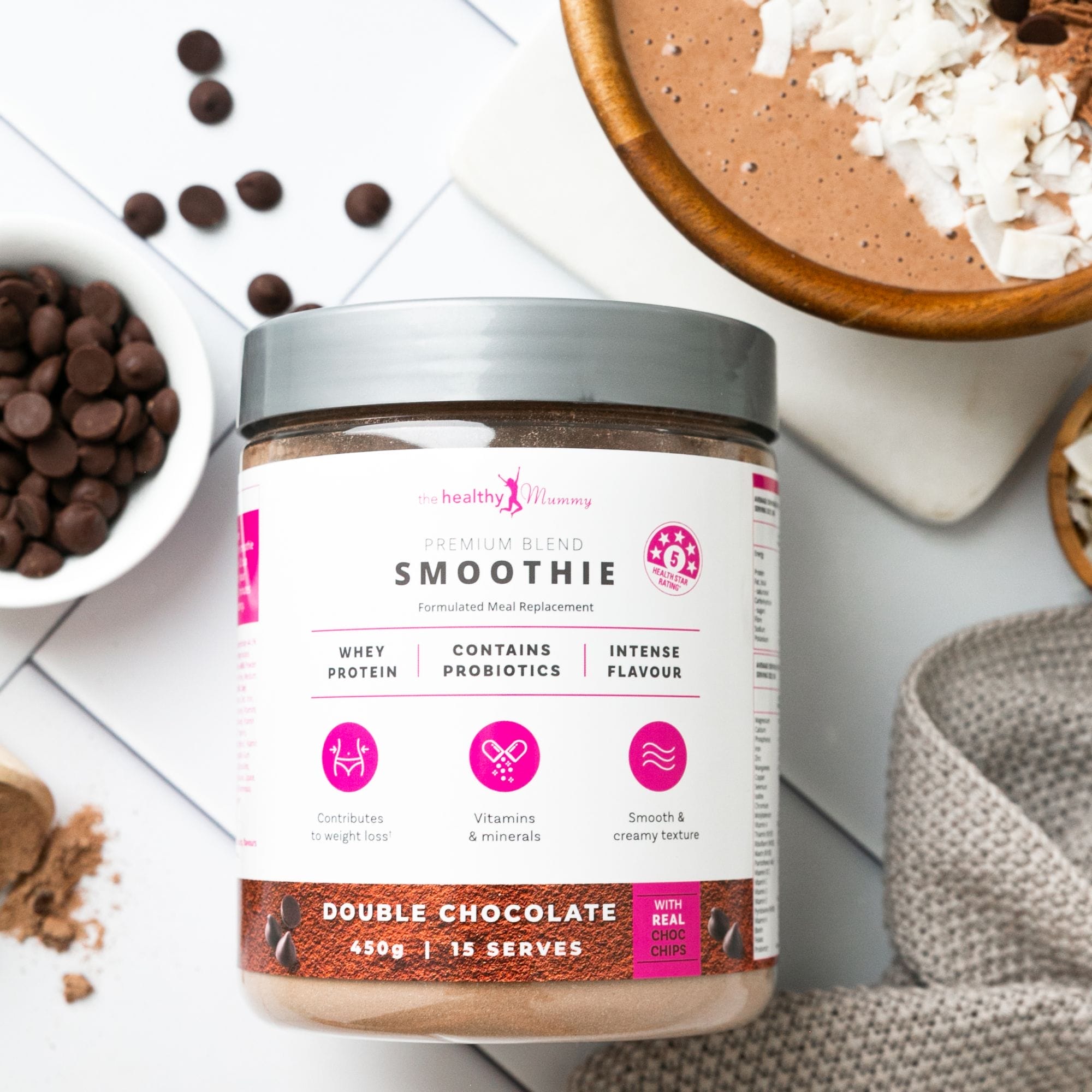
When you have a newborn sleeping on your chest, cooking an elaborate breakfast or lunch is nearly impossible. Many mums end up skipping meals or grabbing nutrient-poor snacks. * **The Solution:** [The Healthy Mummy Meal Replacement Smoothies](https://secure.healthymummy.com/smoothies/) were specifically formulated by Australian nutritionists to be **100% breastfeeding friendly**. * They are free from caffeine, artificial colours, and weight-loss accelerators, offering 25 vitamins and minerals, plant protein, and healthy fibre to keep you full and energized. (Read our guide on the [Best Milk for Smoothies and Weight Loss](https://www.healthymummy.com/different-types-of-milk-what-they-mean-for-nutrition-weight-loss/)).
5. Embrace NEAT (Movement That Doesn’t Feel Like Work)
You do not need intense cardio sessions to lose weight. In fact, strenuous workouts can elevate cortisol and deplete your energy when you are already sleep-deprived. * Focus on **incidental movement (NEAT)**: gentle daily pram walks in the morning sun, gentle stretching, and pelvic floor exercises (discover more in our [8 Ways to Lose Weight Without Exercising](https://www.healthymummy.com/8-simple-ways-lose-weight-without-exercising/)).
3 Reasons Why the Scales Might Not Be Moving (And Why That’s OK)
If you are eating well and moving gently, but the scales haven’t budged, don’t panic. Here is what is usually happening behind the scenes:
1. The Hormone Factor (Prolactin & Oestrogen)
High prolactin levels can make some women’s bodies hold onto a reserve of adipose fat (often 2kg to 4kg) around the hips and lower abdomen as an evolutionary biological insurance policy for lactation. Many mothers find that the final few kilograms release naturally and effortlessly once they begin weaning.
2. Fluid Retention & Heavy Breasts
Lactating breasts can weigh between 500g and 1.5kg more than pre-pregnancy breasts due to engorgement, blood flow, and milk storage.
3. Muscle Repair & Abdominal Healing
Your abdominal wall and pelvic floor are actively recovering. If you have abdominal muscle separation, your stomach may protrude even after fat is lost (read our guide on [Post-Pregnancy Loose Skin and Diastasis Recti](https://www.healthymummy.com/post-pregnancy-stretch-marks-and-loose-skin-help/)).
Frequently Asked Questions
Will dieting reduce my breast milk supply?
A mild, gradual calorie deficit (eating around 1,500 to 1,800 nutrient-rich calories a day) will not reduce your breast milk supply. However, rapid crash dieting (eating under 1,200 calories per day) or extreme carbohydrate restriction can cause a sudden decline in milk volume. Always listen to your body and adjust your calories if your baby shows signs of dissatisfaction.
When is it safe to start trying to lose weight after giving birth?
You should wait at least 6 to 8 weeks postpartum before actively trying to lose weight. This gives your body time to heal from birth, allows your breast milk supply to regulate to your baby’s demand, and lets you recover from early fatigue. Always get clearance from your GP or obstetrician at your 6-week postnatal checkup.
Are The Healthy Mummy Smoothies safe while breastfeeding?
Yes! The Healthy Mummy Smoothies were originally formulated specifically with breastfeeding mums in mind. They are 96% sugar-free, packed with vitamins, minerals, and plant-based protein, and contain no caffeine, artificial sweeteners, dairy fillers, or chemical diet pills.
Why am I so hungry while breastfeeding?
Breastfeeding burns hundreds of calories daily and triggers surges of prolactin and oxytocin, which naturally stimulate appetite to ensure adequate nourishment for lactation. Focus on snacks rich in protein and soluble fibre (boiled eggs, Greek yoghurt, oats, vegetables with hummus) to satisfy that intense hunger without overconsuming empty sugars.
Postnatal Reading
- Rebuild your strength safely with our 8 Practical Steps to Lose Weight Without Exercising.
- Curious about postpartum belly recovery? Read Post-Pregnancy Stretch Marks & Loose Skin Help.
- Need quick, high-protein snacks between feeds? Browse 15 Best Savoury Protein Snacks.
- Explore our 100% breastfeeding-friendly meal plans and recipes in the 28 Day Weight Loss Challenge.


BMI Calculator
Welcome to our FREE BMI Calculator. The Healthy Mummy has helped 100,000's of mum lose weight and regain their body confidence and we are confident that we can help you do the same too.rnrnUse this BMI calculator to check your body mass index (BMI) and find out if you’re a healthy weight
Is Body Mass Index reliable?
Please enter your weight and height as accurate as possible. Your results will appear here.


Be part of our friendly and supportive community
Want FREE delicious recipes, fitness tips and great specials?
© 2026 The Healthy Mummy. All Rights Reserved.




Apple and the Apple logo are trademarks of Apple Inc., registered in the U.S. and other countries. App Store is a service mark of Apple Inc., registered in the U.S. and other countries. | Google Play and the Google Play logo are trademarks of Google LLC.



19,737 Reviews

7,736 Reviews